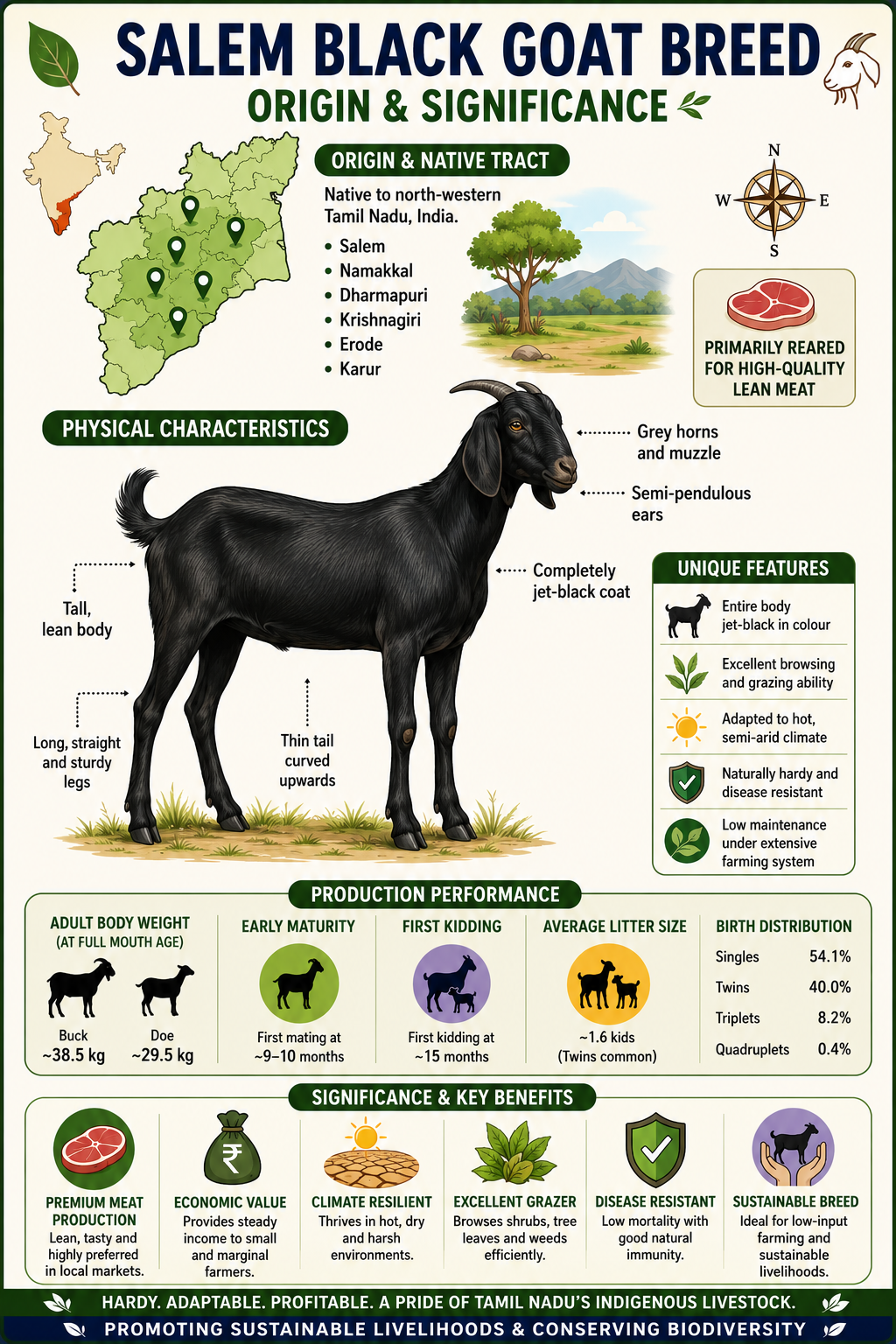
Salem BLACK
Origin: Native to Salem, Namakkal, Dharmapuri, Krishnagiri, Erode, and Karur districts of Tamil Nadu.
Appearance: Tall, lean goat with a completely jet-black coat, grey horns, semi-pendulous ears, and long, sturdy legs.
Primary Purpose: Reared mainly for high-quality lean meat production.
Climate Adaptation: Thrives in hot, dry, and semi-arid tropical regions.
Body Size: A large indigenous breed with adult bucks weighing about 38.5 kg and does about 29.5 kg.
Hardiness: Naturally hardy with excellent tolerance to heat and harsh grazing conditions.
Disease Resistance: Good natural resistance with low kid and adult mortality under proper management.
Grazing Ability: Excellent browser that efficiently utilizes natural shrubs, weeds, and tree leaves.
Reproductive Performance: Early maturity with good kidding performance and frequent twin births.
Economic Importance: Provides a dependable source of income for small and marginal farmers through profitable meat production.
Key Benefit: A low-maintenance, climate-resilient indigenous breed ideal for sustainable commercial goat farming in Tamil Nadu.
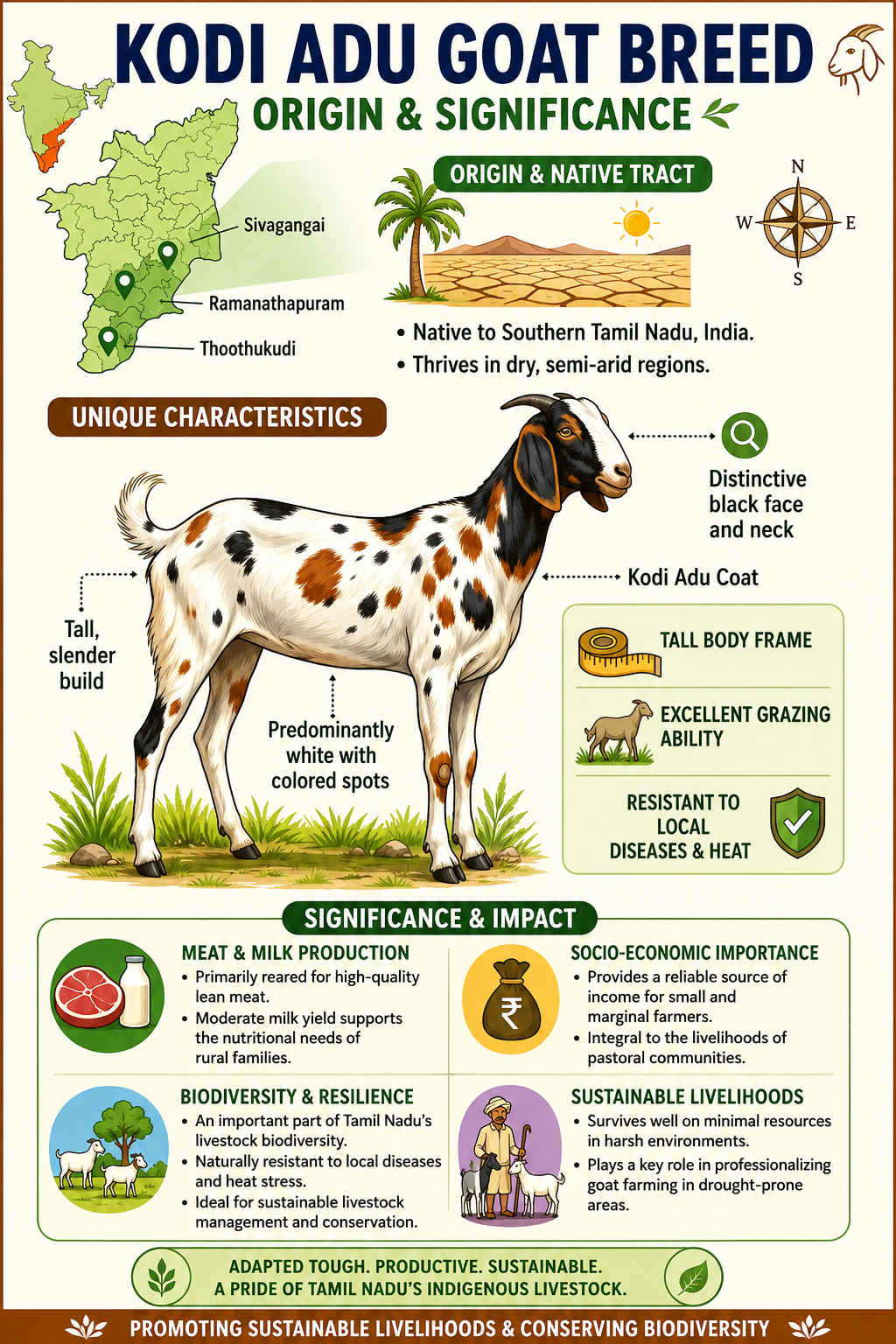
Kodi Adu
The Kodi Adu is a well-known native goat breed of southern Tamil Nadu, valued for its hardiness, adaptability, and economic importance to rural farming communities.
Origin:
Kodi Adu goats are mainly found in the districts of Thoothukudi, Tirunelveli, and Ramanathapuram. They are well adapted to the hot, dry, and semi-arid climate of southern Tamil Nadu.
Physical Characteristics:
Kodi Adu is a tall, lean breed with long legs that enable it to graze on shrubs and bushes. It usually has a white or light-colored coat with black or reddish-brown patches and distinctive drooping ears.
Significance:
- Primarily reared for high-quality lean meat.
- Produces a moderate quantity of milk, supporting rural households.
- Provides a reliable source of income for small and marginal farmers.
- Naturally resistant to heat and many local diseases, making it a low-maintenance and resilient breed.
- Plays an important role in conserving Tamil Nadu's indigenous livestock biodiversity and promoting sustainable goat farming in drought-prone regions.
This combination of adaptability, productivity, and resilience makes the Kodi Adu one of the most valuable indigenous goat breeds of Tamil Nadu.
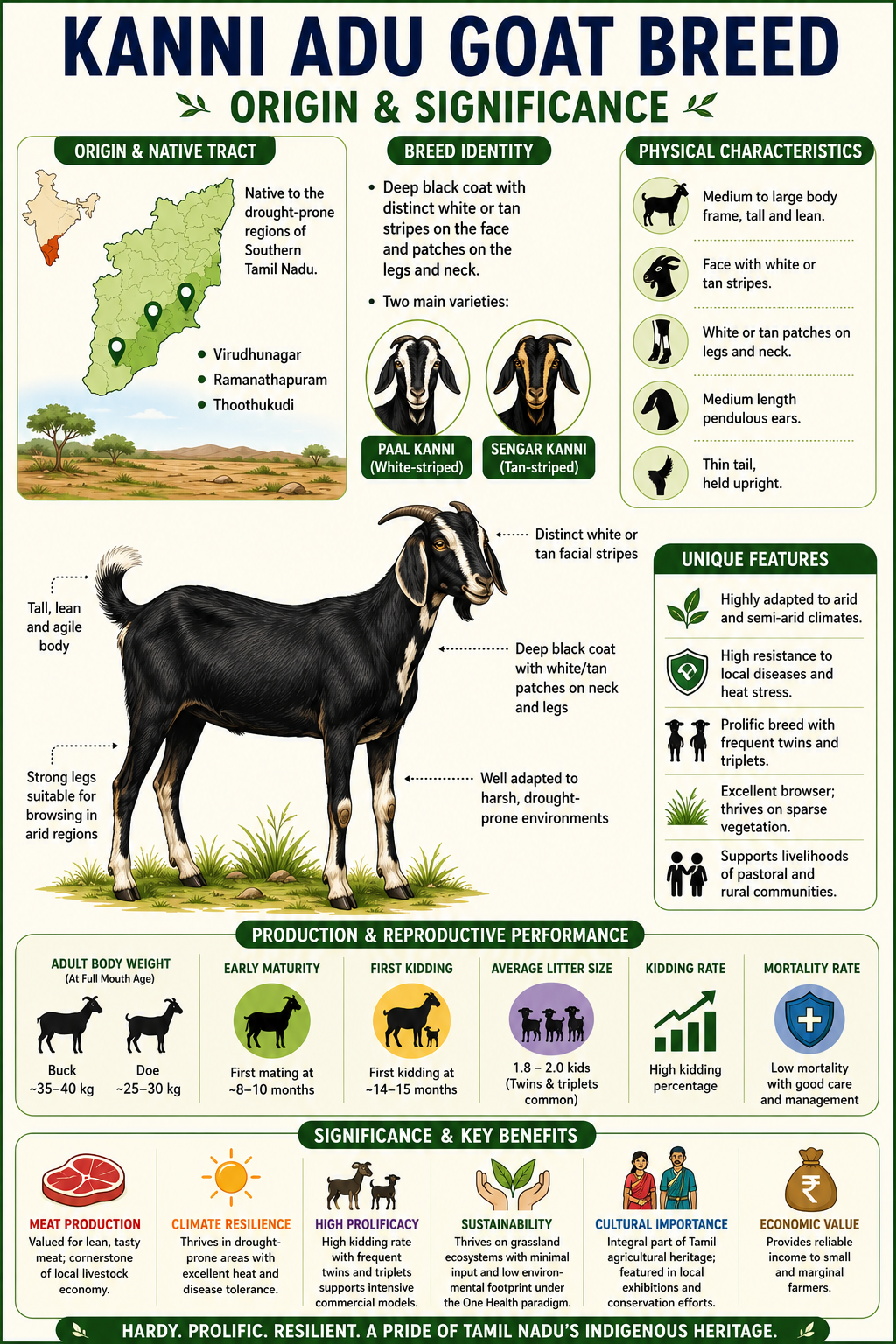
Kanni Adu
Origin: Native to Virudhunagar, Ramanathapuram, and Thoothukudi districts of southern Tamil Nadu.
Appearance: A tall, lean goat with a deep black coat, distinctive white or tan stripes on the face, and matching patches on the legs and neck.
Breed Varieties: Classified into Paal Kanni (white-striped) and Sengar Kanni (tan-striped) based on facial stripe colour.
Primary Purpose: Reared mainly for high-quality lean meat production.
Climate Adaptation: Thrives in hot, dry, and semi-arid regions with excellent heat tolerance.
Hardiness: Naturally hardy and well adapted to extensive grazing under low-input farming systems.
Disease Resistance: Possesses good natural resistance to local diseases and harsh environmental conditions.
Grazing Ability: Excellent browser that efficiently utilizes shrubs, bushes, grasses, and tree leaves in drought-prone areas.
Reproductive Performance: Highly prolific with high kidding rates, frequently producing twins and triplets.
Economic Importance: A dependable source of income for small and marginal farmers through profitable meat production.
Key Benefit: A climate-resilient, low-maintenance indigenous breed ideal for sustainable and commercial goat farming while preserving Tamil Nadu's rich livestock heritage.
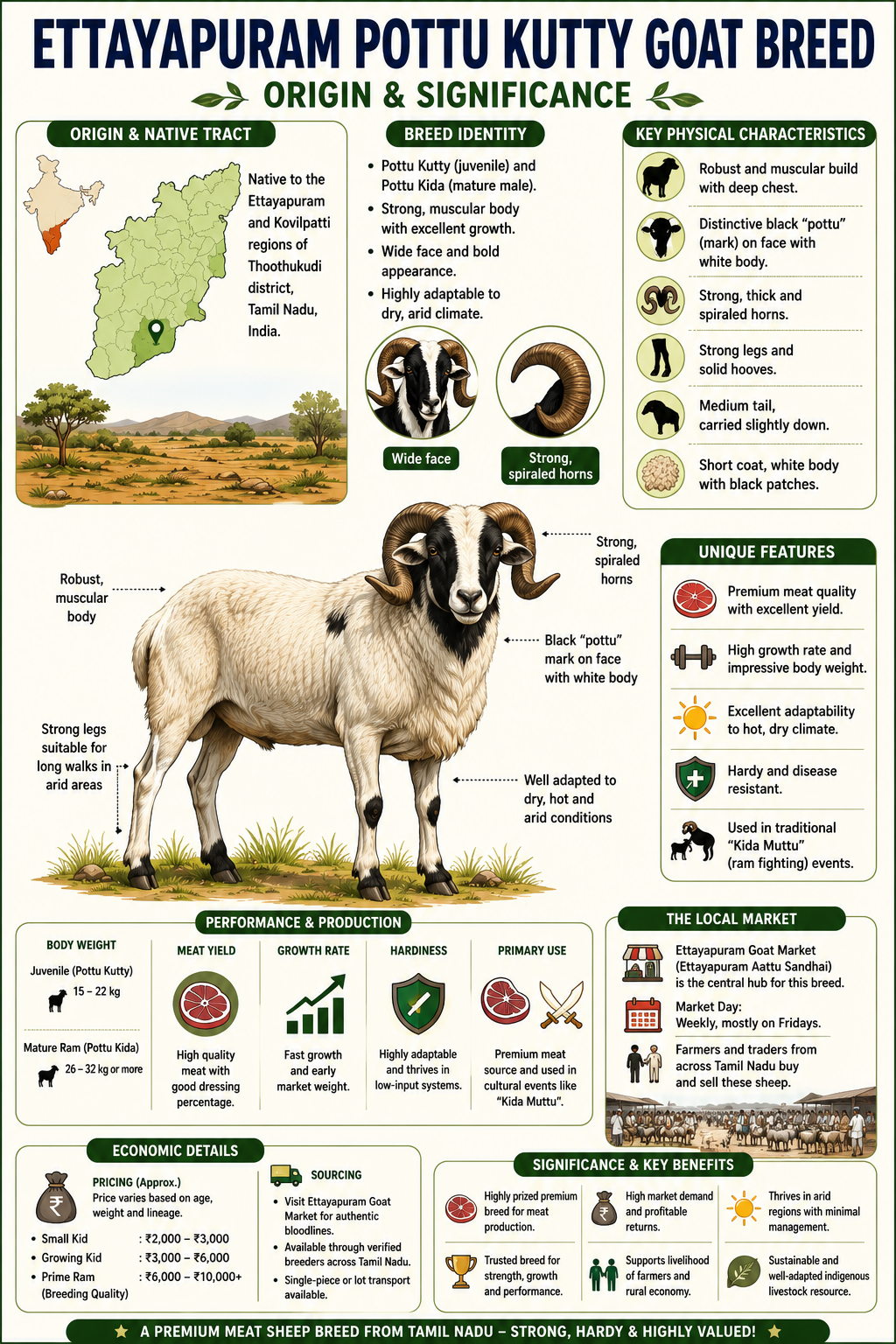
Ettayapuram Sheep
Origin: Native to Ettayapuram and Kovilpatti regions of Thoothukudi district, Tamil Nadu.
Appearance: A robust, muscular sheep with a broad face, strong spiral horns, sturdy legs, and a compact body suited for long-distance grazing.
Identity: Juveniles are commonly called Pottu Kutty, while mature breeding males are known as Pottu Kida.
Primary Purpose: Reared mainly for premium-quality meat and as a prized breed in traditional Kida Muttu (ram fighting) events.
Climate Adaptation: Thrives in hot, dry, and semi-arid regions with excellent adaptability to harsh environments.
Body Weight: Juveniles generally weigh 15–22 kg, while mature breeding rams typically reach 26–32 kg or more.
Hardiness: Naturally hardy, fast-growing, and well suited for extensive grazing under low-input farming systems.
Market Importance: The famous Ettayapuram Aattu Sandhai is the primary trading center where farmers and traders purchase breeding stock from across Tamil Nadu.
Economic Value: Highly sought after for its superior meat yield, breeding quality, and strong market demand, offering excellent income opportunities for farmers.
Key Benefit: A premium indigenous meat sheep breed known for its muscular build, impressive spiral horns, climate resilience, and high commercial value, making it ideal for sustainable sheep farming in southern Tamil Nadu.